

A DETAILED DOCUMENTATION OF THE RESTORATION OF THE PELLISSIER HOUSE MUSEUM DURING NOVEMBER 2025
The restoration of the Pellissier House museum started in November 2025 under the supervision of the Stellenbosch based architect Sam Pellissier who is a fifth generation Pellissier and descendant of Jean Pierre Pellissier who built the house between 1833 and 1835.

The house was in a serious state of disrepair. It has been a good ten years since the government stopped funding the upkeep of the Pellissier house Museum in Bethulie in the Free State. After a lot of petitioning by Trudie Venter, the Provincial Government handed the responsibility of the museum over to her in 2016. She founded the Bethulie Heritage Foundation and this committee has been managing the museum ever since.
In October this year the Bethulie Heritage Foundation, the Free State Department of Public Works and Sam and Ingrid Pellissier, who represented the Pellissier family, held a meeting to finalise the donation of the museum back to the Pellissier family. Sam’s great grandfather donated the house to the Bethulie Municipality in 1972 and stipulated that if the house was no longer used as a museum, it must be handed back to the Pellissier family.
The paperwork to donate the house to the Pellissier Family Trust was finalised in October 2025 and handed in at the office of the MEC of the Free State. Once the paperwork has been signed, the building will once again belong to the descendants of the missionary Jean Pierre Pellissier.
By the first week of November all the necessary permits were renewed and obtained so that restoration could start. The team of local workers started cleaning the garden and working on the building as soon as Sam Pellissier arrived in Bethulie. As architect that restores historical buildings, he was given permission to work on the building instead of the government of the Free State’s architect who would normally supervise such an undertaking.
The main focus of this phase of restoration was to clean the garden and repair damage on the eastern facing part of the house that used to be where the main entrance to the house was.
Restoring the North Eastern wing
The photographs below show the deterioration of the building since 2023.

At first the damage started slowly. The plaster started falling off the wall of the south eastern wing first and then it started falling off the north eastern wing at an alarming rate. The damage started becoming a big concern during February 2025 when Bethulie was subjected to heavy rainfall and storms.

By the end of April the damage was much worse. Chunks of plaster rubble can be seen lying on the grass. This part of the museum has suffered the worst damage during the last season. In addition to the plaster that has already fallen off, a big piece of plaster has pulled away from the wall and can fall down any day. (See at the top right of the wall where the shadow falls under the plaster)

Around the corner of this wing, the damage to the kitchen door can be seen to be severe. The large cracks in the wall was an indication of the extensive damage to the structural support of the building.

The cracks go all the way through the thick wall to the inside of the kitchen. The wooden door and door frame are being kept in place only by mercy and this could be a potentially easy point of entry for burglars. There have been several attempts in the last few years where burglars tried to force their way into the museum. One kick and this door and possibly a part of the wall could have broken if another burglary attempt was made. The window of the kitchen facing east also shows extensive cracks. Water leaks in through the cracks every time it rains and this rots all the wooden lintels of the doors and windows.

The work started in all earnest. The workers Ishmael, Robert, and Michael are from the local Bethulie community. They started by building and securing the scaffolding against the east wall of the north eastern wing. This photograph still shows the trees that grow in front of the entrance. They had to be removed as part of the garden clearing project.

The stabilisation of the building was the first priority. On the left side of the wall, the first metal tie anchor and rod had already been inserted into the wall to stabilise and strengthen the connection between the walls. This cross bracing system uses two diagonal steel members that cross each other to form a rigid frame that transfers forces to the foundation. This prevents the wall from cracking, tilting or collapsing. This is a common technique that is used in the restoration of heritage buildings. It ensures that the walls will last much longer.

There are a variety of different designs of tie rods, but the ones that are used here were selected to match the tie rod that was used previously on the south eastern wing of the house.
Here are a few examples of decorative anchor plates that can be used for different styles of buildings
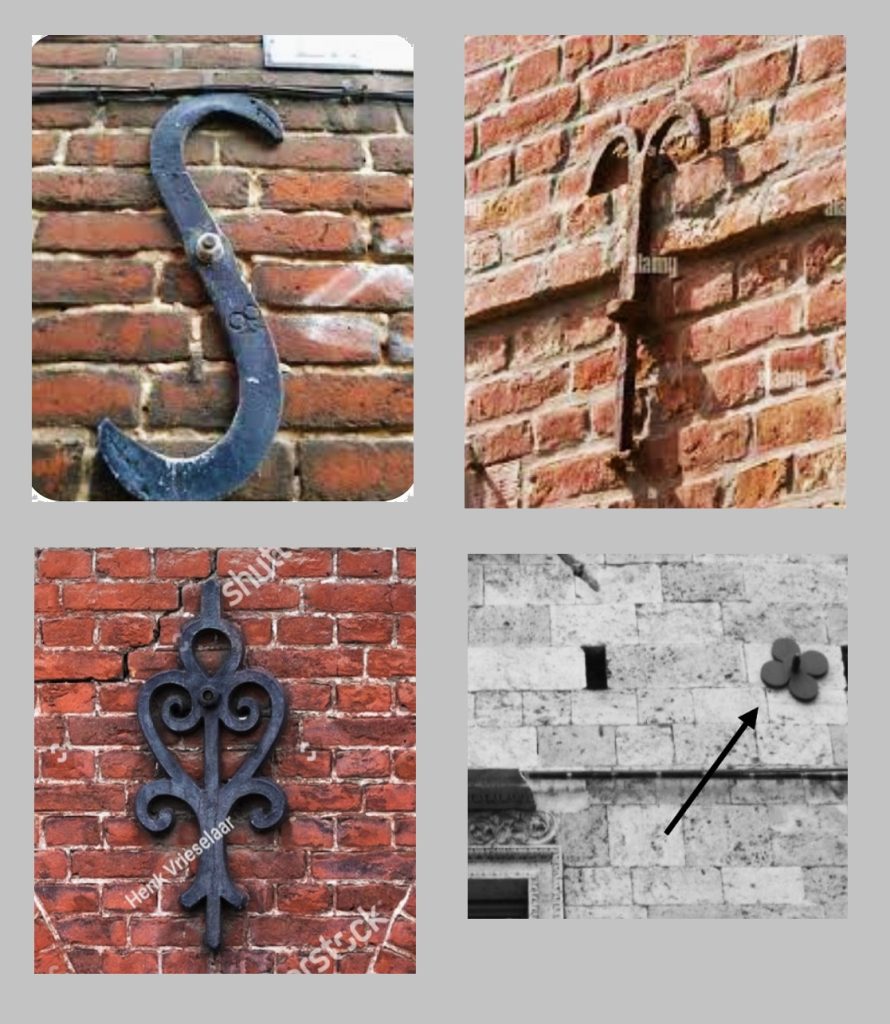
These decorative bolts are the tie rod end anchor plates. Anchors are connected to threaded rods. The rods are connected to existing beams and transverse the walls to connect and anchor the structural walls.

Here both anchors can be seen positioned in place.


The threaded rods pass through the kitchen and on either side of the dining room on the inside of the building.

The rods were connected with steel plates on the original outside wall of the building where the missionary added extra rooms on either side of the original building as the size of the family grew. The distance from the outside of the wall to this position is about 8 meters. The rods were not long enough so they had to be welded together to get to the necessary length.

Here the plates are shown on either side of the north western wing where they will remain to provide structural integrity for the house. This room forms part of the Victorian facade that was added by the Holm family after they bought the house.

All the old, rotten plaster was removed to clean the walls to prepare them for the next stage of the restoration.

Chicken mesh wire was stretched all along the wall and around the corner to cover the wall above the kitchen door. A mixture of water, bonding liquid and cement was sprinkled on the wall to make the old sun baked mud bricks water tight before they could be plastered.

To attach the mesh, holes were drilled into the wall. Wall plugs and screws of about 8cm to 10cm were used to secure them deep into the wall. Steel washers of about 2cm in diameter were used to keep the mesh in place.

After the entire surface of the wall was coated with the cement and bonding liquid mixture and the mesh was in place, the wall was ready to be plastered.
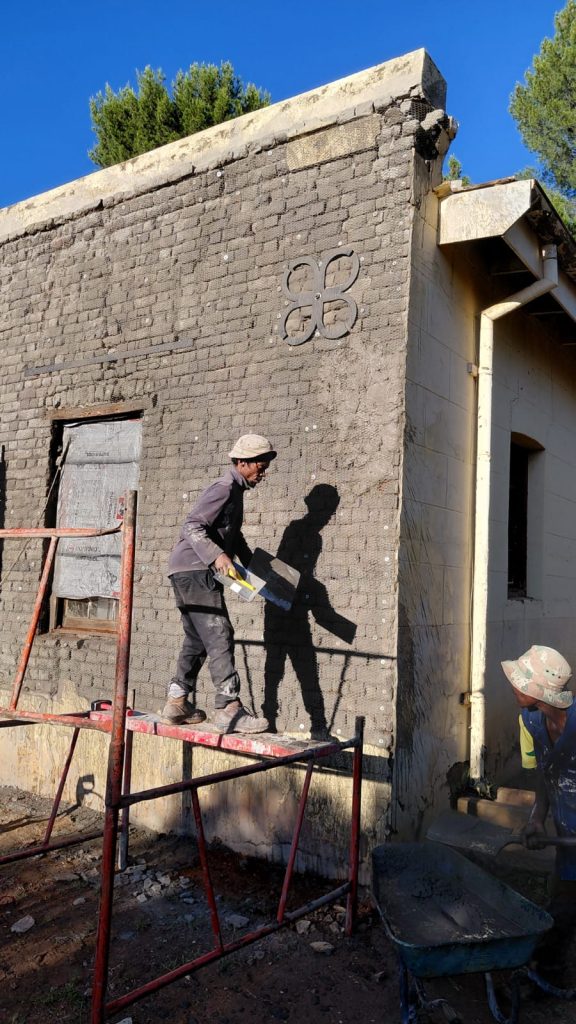


After the plastering, the parapet was made water proof by using membrane and acrylic liquid and all ridges and corners were smoothed and tidied.
Restoration of the south eastern wing

The first major damage to the house occurred on the south eastern wing. Plaster fell away from the clay bricks exposing them to rain water. The bricks started to perish slowly because they were not oven baked bricks, but sun dried bricks made from mud and straw. Every time there was heavy rain fall, the damage increased. The wall needed to be repaired urgently. The damage was not just on the outside of the wall but on the interior as well where the ceiling got damaged and the plaster started to fall off.

The old plaster was cleared from the wall and the deep holes and cracks were clearly exposed where the rain water caused damage.

On this wing, the workers started by first sprinkling a mixture of cement, water and bonding liquid on the bricks to make them water tight.

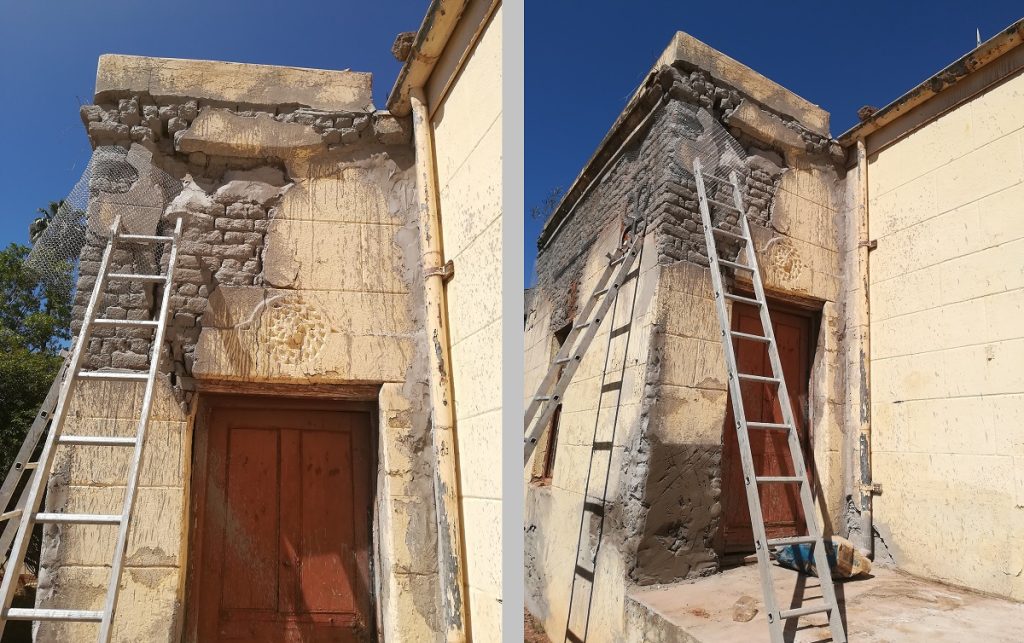
After the surface was prepared for plastering the cross bracing was inserted on the right side of the wall. The photo above on the left shows the cross and threaded rods on the floor of the porch ready to be used. The photo on the right above shows the cross bracing that was inserted in a previous restoration on the left side of the wall. The anchors that are used for the current restoration matches with the one that was used before.

The holes were drilled and the threaded rod inserted.
A modern laser level was used on the inside of the building to position the rods into a level position.

Mesh was used to cover the surface of the wall where plaster was going to be done. It was secured to the wall using wall plugs and screws.
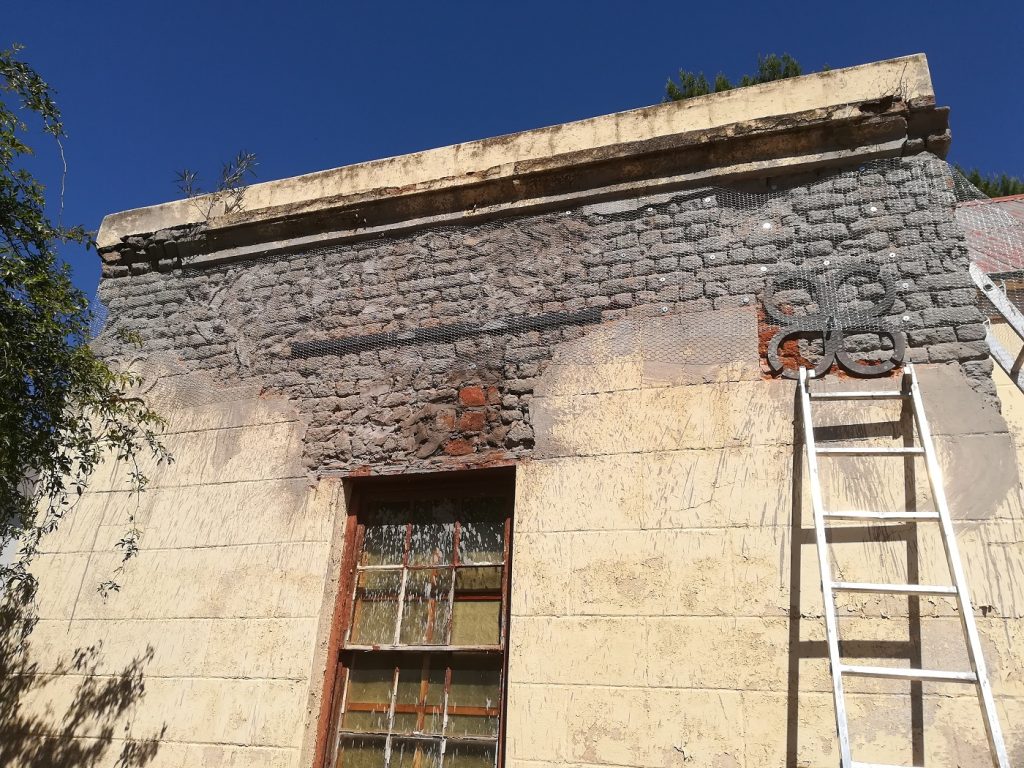
Final surface preparation was done on all the small areas and the wall was ready to be plastered.

Cleaning the garden
While all this construction was being done on the building, there was a massive undertaking in trimming and cutting away old and dry branches of the trees that have been growing out of control for years.

Trailer load after trailer load of branches were removed. It was not just taken to the dump site to throw away, but taken into Cloetespark, the rural area, where a lot of the locals are still depended on fire wood for cooking and to provide warmth in the bitter cold Free State winter. The wood was distributed and off loaded in different areas to give access to a larger number of people.

The garden was tidied up after the last of the branches were removed and was transformed from chaos to order. It was made ready for the next phase of restoration that will be started in February 2026. The goal is to restore the garden to its original glory the way that Martha Pellissier had it laid out during the days of the missionary station.
The plastering was completed and the site cleaned up. The plaster will now dry and settle and give protection against the severe storms that occur during the summer in this town. When the restoration recommences in February, the building will be painted and further repairs will be undertaken.
The progress that was made on this historical building in eight days was phenomenal and we are looking forward to February 2026 when the second phase will start.

The old house has always been a beautiful building, but now it will be a sturdy and strong building that will last at least another 100 years before it will have to be renovated again. The Pellissier family is working hard and investing a lot of money to make sure they leave a legacy for the next few generations.
You can also become a part of this process by contributing financially to this project.
If you would like to make a donation to contribute to the restoration of this precious historical building, you can use the following bank details:
First National Bank
Pellissier Family Trust
Demand Deposit Account
Account Number: 629 1126 5165
Branch number: 261 050
SWIFT code: FIRNZAJJ
Address: 1 Voortrekker Street Bethulie, 9992
Donations can be made anonymously or you can use your name as reference.